Posts Tagged ‘NASA Tom’
Unforgettable Experiences – NASA Tom
Reprinted from DankowskiIntelligence 4th edition site link
To purchase NASA Tom’s outstanding metal detecting DVD, click HERE
UNFORGETTABLE EXPERIENCES
It was one of those days where, due to life’s events and demands, I had been deprived of “time”. Detecting time. Nearly a full month since I had last detected. So, the fever was extraordinarily high, the temperature was cool and the time was finally available. Good sites were becoming increasingly sparse, but my attitude that day was: “I’m POSITIVE I will succeed”. The attitude you carry into the field can make all the difference in the world. And indeed, on this particular hunt, “positive attitude” fully validated itself.
The area was a 4 acre field in Oak Hill, Florida where I was informed a country store once stood. The store burned down in the Fall of 1920, was never rebuilt and the property abandoned/uninhabited since then.
I had detected the property twice before, fairly extensively, to no avail. Only a few clad coins were found, speculating from passer-by transient hunters. I was certain of the tip that I received in 1997 from a man of whom was born in 1911 and worked at the store in 1919 & 1920 as a helper. In fact, in 1997, it was my CZ-6a that verified a ton of charred nails in the ground, exactly where the man claimed the structure once stood. I could not successfully detect where the structure once stood because the volume of nails were excessive and anything else would be completely masked.
As I walked a path directly away from the iron nail pit, the amount of detectable
signals in my headphones diminished rapidly – to the point of virtually pure silence
about 60 feet away from where the structure once stood. Only a few very deep mid-tone trash items existed along with a few sparce rusty nail signals; exceptionally quiet soil. I recall being surprised with the silence of nearly no metal objects in the ground, yet I wrote it off in my mind as a target-poor, clear site.
Flash-forward on the time continuum to February, 2004. Armed with a new CZ-3D, a positive and demanding attitude, I went back to this pounded site. Positively knowing
there just had to be something worthwhile at this site that would be indicative of the era, I began hunting.
I started the search about 70 feet away from the nail infested area where the building
once stood. Targets were few and far in-between in this area, and mostly consisting
of sparse low-tone nails. Then I detected a very weak, nearly consistent high-tone (zinc penny) reading. In my headphones, the target sounded very deep and also large; about the size of a crushed beer can. Nearly certain it was a piece of tin or copper roof flashing from the old building, I decided to dig it out of the way anyway.
As I began to dig, I suddenly remembered that I had started to dig this exact same target in 1997, but changed my mind due to the fact the older CZ-6a read the target as a trash mid-tone at a labor-intense depth. The CZ-3D read high-tone, so I dug a 12” x 12” x 12” cube of sod out of the Earth. Sweeping the coil over the removed plug yielded nothing. Dunking the 8” coil into the hole, the detector would then report an expected large target in the bottom of the hole. Digging about another half-foot of dirt out of the hole, then sweeping the coil in the hole once again, the detector now reported many broken signals. Realizing that I had hit the roof flashing with my shovel and broke it apart, I decided to router out the hole a bit more. Dunking the coil once more, down into the Earth, I then heard only one weak, short beep. Most of my error and mess would now be in the excavated dirt pile.
I swept the dirt pile and heard my multiple errors. I decided to remove each piece of roof flashing out of the dirt pile, one at a time. In a visually induced adrenaline depleting experience, the first target was a Indian Head penny. Then a ‘V’ nickel. Then another Indian Head penny. Then ANOTHER ‘V’ nickel. Then a Barber quarter. Then 3 more consecutive Indian Head pennies. Coin spill of era! -The dirt pile was now sans metal. BUT, the hole still had one more weak signal. In my unsuspecting, haphazard digging efforts, I had no idea of the critical information as to the exact depth of which these coins were at, but now I would be much more cautious.
Much success comes from being intuitive to specific soil signatures; a critical part of detecting intelligence. Fortunately, the one remaining target was not in the loose dirt in the bottom of the hole, rather, it was deep in the sidewall of the hole. Sweeping the coil from the surface of the Earth, the target was not detectable due to excessive depth. It was only detectable with the coil deep down in the hole and to the West sidewall. I decided NOT to scrape out the sidewall, rather, I would carefully dig another
plug from the surface of the ground and meticulously ascertain an exact depth of where the target was at. At exactly 16”, I yielded 2 more Indian Head pennies stuck together! These pennies were located about 14” away (outward) from the main spill. Realizing I was in a large field in the middle of nowhere, I knew I could ethically dig a moon crater and no one would care. So, I removed 10” of top soil in a 4 foot radius. This labor intense effort yielded yet another Indian Head penny at 16” deep. Physically exhausted, I covered my hole and returned home. Carefully cleaning the coins, I analyzed each one with heavy scrutiny.
The newest coin was a 1908 ‘V’ nickel. Although somewhat corroded, it was nearly mint-condition new. I surmise the coin spill took place in 1909. All of the other coins seemed to support this datum. The country store was built in the early 1880’s and had seen nearly 40 years of service. Sixteen inches = 1909 strata soil. Hmmmmm. If not for a large target coin spill, I would have never detected these coins individually.
It was not until July, 2004 (5 months later) when I realized that I should try the 10.5” coil in the remote areas surrounding the once-standing structure. I had ‘written-off’ the area as undetectable as the wanted targets were at inaccessible depths. The large coil would give up to 15% more depth in Florida’s mineral-free soil if used properly; however, I was fairly certain this would not be enough of a depth boost to ascertain success. Needing 16” depth capabilities on single pennies and dimes would be asking slightly too much from the large coil. It is a normal occurrence for the 1909 soil strata to be at a 16” depth in Florida; in fact, it is actually categorized as “stable soil conditions” in this tropical State.
I arrived on site in the early morning and after a hard rain. As long as iron targets were not abundant, the wet ground would help detecting
capabilities slightly. For a good starting
point, I began detecting right at the infamous
coin-spill spot. The ground seemed to ‘come alive’ quite a bit more with the larger coil. With the 8” coil, the ground was silent. With the 10.5” coil, the headphones became busy with targets. Because of the era of the site, my intent was to recover all mid-tones and high-tones (everything that was non-ferrous). Most of the mid-tones would turn out to be crushed buttons, suspender clasps and fired shotgun shell casings.
Within the first two minutes of detecting, I received a very deep high-tone signal, less than 5 feet from the coin spill spot. This particular
signal was so weak that if I were to raise the coil about 3/4” above the target, all intelligible data would be lost. Being careful not to damage the target and also to ascertain a exact depth measurement, I found ANOTHER mini coin spill. At 15-1/2”, I recovered a 1917D Walking Liberty Half Dollar which was almost directly on top of a pair of Standing Liberty quarters; a 1919 & 1920. The 1920 quarter was almost completely Uncirculated with nearly full mint luster. To date, this is the best condition quarter I have ever recovered. The 1919 quarter was About Uncirculated. I believe that I can safely say that these 3 coins were lost in the Spring of 1920.
Approximately 7 feet away from this spot, I received an even weaker high-tone signal. This particular signal was within 1% of the detectors maximum depth capabilities, as the coil could not be lifted 1/10” above the ground, or the target would be completely lost. The target sounded like ground chatter, but it was repeatable ground chatter and in one specific pin-point location. At 15-1/2”, I recovered ANOTHER 1917 Walking Liberty Half Dollar. And four feet to the West of this spot, I recovered ANOTHER Half Dollar at 15-1/2” depth, again. This time it would be a heavily worn 1908 Barber Half Dollar. That’s 3 Half Dollars and 2 quarters ($2.00 face value) in less than 10 minutes; a record-breaker for me.
It is such a rare occurrence that soil conditions are so clean and clear, so as to allow unconditional maximum depth capabilities on targets at such extreme depths with no target masking – which would prevent the detection of these deep coins. I am quite certain that all of these coins were lost in a moments time, by the same person. And $2.00 in 1920 was more than one days wages for many folks.
I continued to hunt for an additional 6 hours and had no further success. I should have turned the detector off and went home after the 1908 Barber Half Dollar.
Hindsight! In retrospect, I recovered only large coins of substantial mass and coin spills. Smaller coins; dimes, pennies & nickels are less than half the mass of a large Half Dollar. In fact, a dime is exactly 1/5 the mass of a Half Dollar (by no accident). And at 15-1/2” 1920 soil strata, 16” 1909 soil strata, and a suspected 17” 1890 soil strata, all of the smaller coins are still perfectly safe, deep inside the Earth awaiting a future generation, deeper technology metal detector. Current technology is preventing anyone from ever accessing these coins. I sure would like to rent a Bobcat and scrape off the first 13” of topsoil in a 200 foot radius surrounding where the building once stood, and detect the sight all over again. I suspect there are approximately 200 coins (pennies, nickels, dimes & quarters) still remaining in the ground at this particular site; lost during the period from the early 1880’s to the Fall of 1920. The older gentleman of whom gave me the tip; the knowledge of where to hunt, had since passed away sometime after 1997. It would have been a deep honor to share any/all of these finds with him, as this specific place on the Earth was much a sacred part of his memorable life. — Godspeed.
Paid in Cache! – NASA Tom
*Reprinted from NASA Toms site site link
To purchase NASA Tom’s outstanding metal detecting DVD, click HERE

About 4 weeks ago, Mike recommended a park in Titusville, Florida that we should hunt. I am an extremely positive person, yet I complained to him about something that I have always preached the exact opposite about. My complaint: I have never passed by this park without seeing at least a minimum of one THer hunting this park. I pass by this park every day after work so I think I could safely say that this park has been hunted over 1000 times. Mike had just purchased the identical top-of-the-line Fisher detector that I have and after some schooling in my test garden and validating the new detector, I accepted his offer to hunt the park. In a short period of time, Mike and I would come to realize the importance of my test garden. The park is about 110 years old and consists of approximately 10 acres of land. Upon arrival to the park I analyzed the soil conditions and rendered 9 of the 10 acres undetectable for various reasons. I knew that only about an acre had potential to produce. In time, this proved to be correct. Mike wanted to watch my techniques for a few minutes before he commenced. In 4 minutes, I pulled 3 mercury dimes at the 10.5 inch calibrated depth mark (graduated shovel). Mike was done watching! He put me to work in one area and he went to another area. In just a few minutes he came running over to me with an 1888 Indian. A few hours each day and several days later, this particular acre produced 3 Indians, 2 Buffaloes, 37 Mercurys, 1 Washington, 1 standing Liberty, 2 Walking Liberties, and several dozen early wheats. Ironically, nothing came out of the ground from 0 to 8 inches. This credit goes to all the other THers. Everything was at the extreme fringe capabilities of these detectors. Mike was startled with the performance of his new detector. Of course, we work “by-the-book” with the coil parallel to the ground lightly scrubbing the grass, slow, methodic, overlapping sweeps and if the natural landmarks are poor, we even use colored plastic spikes to segment small areas at a time, never loosing track of property.
Thomas J. Dankowski Bio – NASA Tom
Reprinted from DankowskiIntelligence 4th edition site link
To purchase NASA Tom’s outstanding metal detecting DVD, click HERE
Biography: Thomas J. Dankowski
Born in 1962, Thomas J. Dankowski is presently employed at the Kennedy Space Center in Florida, currently working with NASA’s Space Shuttle program and the assembly of the International Space Station. With the utilization of visual and navigational landing systems, he has been training astronauts and cosmonauts how to land, for the past 15 years. Previously, Thomas was a Naval nuclear powered fast-attack submariner.
Thomas purchased his first metal detector in 1972. Then, in 1973, he found his first ‘significant’ find; a rare 1856 Flying Eagle U.S. one cent coin. At the age of eleven, he sold the penny for $700.00 and never told his parents. From that point forward, he was “hooked” into this wonderful hobby of treasure hunting. With this specific experience Thomas claims: “This is where I learned money-management. It took me 2 years to spend the $700.00. Grateful for this positive incident, however, I regret selling such a rare coin – as I no longer have ‘proof’ in my custody with this key-date coin”.
At the time of this writing (July 2002) Thomas has accrued 30 years of detecting
experience. It has simply been a fanatical hobby for him, until recently. In more recent events, Thomas has helped locate murder weapons for FBI and police departments
who have all but given up on feudal searches; helped NASA locate metal items in certain, specific projects; located iron spikes and nails in lumber logs entering industrial saw-mills; located a projectile/bullet in a gunshot victim for an ambulance crew (pin-pointing accuracy took on a new meaning!); Found the usual domestic-dispute “lost” wedding & engagement ring sets; located a ‘misplaced’ buried cache for an individual; and the list goes on.
Thomas’ primary treasure hunting interests are finding the extreme depth older coins. A good relic hunt occasionally piques his interests. Thomas claims that launching Space Shuttles is his hobby and that treasure hunting is his profession. He has trained hobbyists and professionals how to use a metal detector in a wide variety of applications. Frequently, Thomas gives educational lectures at seminars and local treasure hunting clubs. He has written many ‘very technical’ articles pertaining to the hobby, produced a professional training video, and works with Fisher Research Laboratory R&D department on current production and future metal
detector concepts. — Who knows, using a metal detector on Mars to find mineral deposits and metals might be in our space programs future!
Love is Deep! – NASA Tom
*Reprinted from NASA Toms site site link
To purchase NASA Tom’s outstanding metal detecting DVD, click HERE
Love is Deep!
Thomas J. Dankowski
Unedited version
Published in Western & Eastern Treasures, March 1999
Just how important is depth? Why do objects sink at different rates? Ever hear statements like, “gold is so-o-o-o elusive”? Read on; I think you will be pleasantly surprised with the knowledge of basic physics.
There are so many misconceptions about these questions that I feel the urgency to clarify these questions. I too have heard gross statements/fallacies/misconceptions AND coming from reasonably intelligent people to boot! If there is one word I want you to remember out of this article it would be, without fail, DENSITY! For the hobbyist it’s moderately important. For the amateur or the professional detectorist it is critical.
Recently, I went to the beach to perform a comparison test between two leading brand detectors. My test target was a woman’s simple gold band of medium thickness. I had about 35 inches of thin dental floss tied to the ring so I would not loose it. I dropped the ring on the wet sand (holding on to the floss), set my shovel down, placed the headphones on my head and set the controls of the detector. Now, I was ready to dig a measured depth hole in the sand to bury the ring. When I looked down at the ring, it was gone! As I held the floss with only a slight amount of slack, I watched the ring sink slowly to a depth of 23 inches before it stopped sinking. Why did it sink? What made it stop sinking? Was this an unusual, unique circumstance? This couldn’t be a better example to demonstrate the principles of density. First, gold is a very dense material in relative comparison to other items we have here on earth. For a better understanding of density here is a correct illustration. Take the new United States clad dime. It weighs 2.27 grams. Now look at a United States quarter-eagle ($2.50 gold piece). It is nearly identical in diameter and thickness compared to the United States dime. In fact, it displaces the exact amount as the dime. But, the quarter eagle weighs 4.18 grams. That’s nearly twice the weight! The gold piece has nearly twice the density as in comparison to the clad piece. Now, which identical size coin do you think would sink faster? ! !
Left Behind – NASA Tom
*Reprinted from NASA Toms site site link
To purchase NASA Tom’s outstanding metal detecting DVD, click HERE
Left Behind
Thomas J. Dankowski
Unedited version
Published in 2000 Silver & Gold annual
(Western & Eastern Treasures annual)
On a recent sunny and slightly cool Tuesday, I decided to play hooky from work and try out my newest acquisition. I just purchased a new Minelab SD2200d metal detector. I had so much fun on that memorable Tuesday that I just have to share the excitement. With certainty, I am not trying to promote Minelab, although I must say that I am in shock by its stupendous performance. It is not a toy. On the beach, its performance is truly above all others. Although the Fisher CZ is still my favorite metal detector, I will let the performance and the finds of the SD2200d speak for itself.
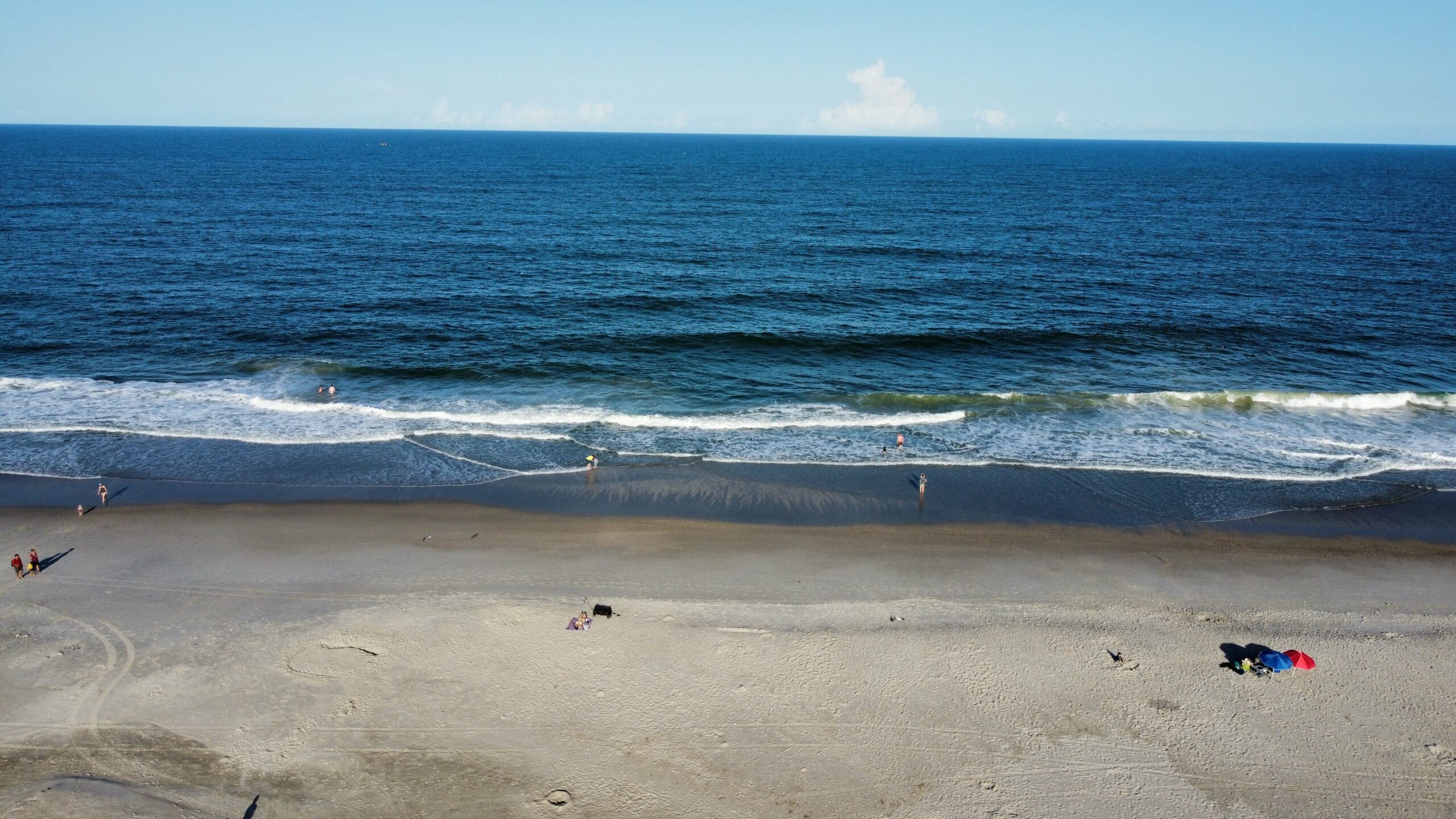
On this particular Tuesday morning, I arrived at a Florida beach only to find 2 other detectorists methodically hunting my favorite trough. Disappointed, I marched down the coast a few hundred yards. I dawned the somewhat uncomfortable battery backpack and powered up the new detector. Instantly I found a rusted bottle cap. Then a pulltab. Then another pulltab. Then I found a tiny gold earring retention clasp smaller than a BB from a BB gun at approximately 4” deep. Then a zinc penny at 14” deep. Then another on the surface. A rusted fishhook soon followed. Instantly gaining respect for the detector, I continued on. Chirp, chirp. A small gold, heart shaped ring 13” deep and weighing in at 1 gram was an exciting score.
Now I had an audience. The two other detectorists no less! They had been watching me, unannounced, for a few minutes. Their attempt of quietly spying on me subsided when one of them audibly squirmed when gold was struck. Feeling obligated to introduce themselves after blowing their cover; I now have two new friends. But not until after they both chuckled at my customized, graduated (in inches) shovel.
After a short show-and-tell session of sharing our finds, the two men invited me over to where they were hunting – only because I put my foot in my mouth. I exclaimed to them that I find what all other THers left behind! After that bold statement I quietly prayed: “Minelab don’t let me down”! One of the THers did find a gold wedding band and a silver pendant with his Minelab underwater unit. This is one of the reasons why his curiosity piqued when he laid eyes on my Minelab.
Walking in their exact footprints I immediately found a rusted bobby pin at 7”. The two men laughed. Then a rusted screw cap at 16”. They laughed again and claimed that I did not know how to use discrimination. Through embarrassment, I quickly realized how handicapped I was by learning what the definition of ‘surface discrimination’ is that this SD2200d employs. Just about everything I found on the beach was well out of range of the detectors discrimination capabilities. Another rusted fishhook accompanied by laughter. Then at 19” deep, resting on the hardpan, a woman’s diamond engagement ring of 14KT gold came out of the wet sand, followed by laughter. MY LAUGHTER!
Then the detectors threshold hum muted, indicating surface iron. I dug the object anyway, exclaiming this target is iron. This was the first time that I encountered the very limited surface discrimination capabilities of this particular detector. The surface discrimination worked properly. By the way, the “double D” coil is the only coil that will engage the surface ID circuitry. The monoloop will give about 4% greater depth but the limited ID circuitry becomes severely handicapped without the double D coil. Please understand that this is a leap in technology to even have this ID option with pulse induction. It’s a little crude, but it’s a first! Who knows what the future holds! (Kudos = Bruce Candy)!
What was the iron object recovered? How about a beautiful, perfect, functioning Swiss Army stainless steel pocketknife! Not all iron objects are bad.
Chirp, chirp. A nonferrous pulltab. Chirp, chirp – another pulltab at depth. This gained the two guys’ attention (and respect) as they were discriminatinating out only the iron and recovering all nonferrous objects. Now I was given specific instructions to mark each target with an ‘X’ in the sand and allow them the opportunity to pass their coils over my targets as it now became evident that it was no longer a coincidence of a large volume of missed targets by their machines. This portion of the testing concluded that I had minimum 85% greater sensitivity over their machines.
The first target that I marked for their analysis turned out to be another gold earring clasp at 6” deep. A gold cross earring at 9” was the fourth ‘X’. A few more foil/pulltab trash items followed by a gold heart-shaped locket at a depth of 11” – laughter ensued. Finally, an apology and a pat on the back for my graduated shovel idea.
Another gold ring, with initials, was picked off of the shell/gravel hardpan at 19” deep. AGAIN, another 14KT gold dolphin ring pulled from the hardpan. Then an 18KT gold pendent of Mickey Mouse at 14” deep. It’s obvious that gold likes to collect in localized pockets on the beach. I have a gut feeling about these very successful finds being indicative of future results. Especially if I can continue to find the hardpan!
Three men walked away from the beach astonished! Yes, I dug a fair amount of trash with the pulse induction machine, but all in all, I walked away with 5 gold rings, one silver ring, a gold herring bone bracelet, several earrings and a large handful of clad coins. This is the most success that I have ever had in one day. I have always dreamed about this type of success!
One good thing about small iron objects in the salty ocean environment is that they will rust and disintegrate in a very short period of time. This is why the percentage of iron objects found on the beach is substantially less than of those found inland.
I must say that I am startled at just how much people lose! I’ve even had people laugh at the hobby and proceed to tell me that I will not find anything of value. Jaw’s drop when I pull out of my pocket a small handful of glittering gold. Suddenly, TH’ing becomes one of the most interesting hobbies they have ever been exposed to. Laughter of humiliation becomes laughter of giddiness. It’s got to be one of the neatest things to watch a full grown adult metamorphically transform into a child, starry eyed, glittering with fantasy. Total nirvana is acquired when a person witnesses the actual digging and recovery of a studded precious metal from the depths of the wet sand. If only I had a dollar for each person I’ve recruited into this world of fascination!!!
Happy intelligent hunting!
Thomas J. Dankowski
Unedited version
Published in 2000 Silver & Gold annual
(Western & Eastern Treasures annual)
Hunt Wisely – NASA Tom
*Reprinted from NASA Toms site site link
To purchase NASA Tom’s outstanding metal detecting DVD, click HERE
Hunt Wisely
Thomas J. Dankowski
Drafted…. April 2006
Unedited version
Submitted to Fisher Research Laboratory for inclusion into the
Fisher Intelligent Hunting 5th Edition.
The Pulltab! Introduced in 1962
It seems that every time I go hunting, I can never just simply ‘hunt’ and enjoy a basic coin-shoot. Rather, I always turn it into a research project or a experiment. This usually includes spending large amounts of time recovering many ‘trash’ signals. Occasionally, my hunting partners will wax me in the volume of “keeper” finds, then commence boasting – to playfully ruffle some feathers.
It was late in 1999 when I took on such a project. My quest was to find; “At what depth was the 1962 dirt strata”. This was the year that a detectorists nightmare debuted; the aluminum pull-tab. — Thousands of targets were dug and depths were carefully measured. Initially, I thought that it would be the coins (because they are dated) that would give the best and most conclusive data for dating the depth stratums — especially from the coins that were nearly uncirculated when they were lost. However, unexpectedly, the pull-tab with its many differing varieties provided the most precise data. Some certain style pull-tabs had a life-cycle of only a few weeks. It is safe to assume that these specific pull-tabs were lost during their active life-cycle; a 8 month old RC Cola may not taste so good — expiration date aside. The sink-rate of differing density metals must be taken into consideration along with ground moisture, cumulative foliage, grass root structure, dirt density/composition, ground activity and any other data altering occurrences, so as to remove as many variables in order to ascertain quantified research validity.
Conclusive analysis was achieved in May, 2000. The 1962 strata of dirt was located at 9.22″ deep. Several places in Florida, Georgia and California supported this data. In some areas, the sink rate was worse and in other areas the soil provided greater stability with the older targets being located at shallower depths as a resultant. This sink-rate data represents the median average. At the time of this writing (April, 2006), I surmise the 1962 median average soil strata is at approximately 9.5″.
What good is this data? Well……. many decisions & conclusions can be formulated with such information. In bullet form:
* Use a deep seeking unit.
* Find areas where soil has a slower sink-rate.
* Recover only the deep targets under these high sink-rate conditions.
* Use a large coil in areas where targets are sparse.
* Recover the pull-tab signals at the pre-1962 dirt depth strata’s.
* New England States are lucky! (Slower sink-rate dirt).
* Sink-rates can vary dramatically from site-to-site and State-to-State.
* A superior detector may not be the answer.
* You may experience that 9 out of 10 places you hunt will produce nothing old
– only clad coins at deeper depths.
* Promise yourself NOT to get discouraged.
* Accept the fact that many premium looking, ‘prime sites’ have sink-rate soil
failure conditions.
* You may experience conditions where dirt mineralization is so severe that even
the top performing detectors, multi-frequency or otherwise, may not be able
to detect a coin exposed on the surface of the ground.
* Educate yourself FIRST about ‘dirt conditions’
—then, secondarily about top performing detectors.
VERY CRITICAL order-of-events!
Hunt Wisely!
Happy Intelligent Hunting
Thomas J. Dankowski
Head-to-Head Comparison Testing – NASA Tom
Re-printed from NASA Toms website site link
To purchase NASA Tom’s outstanding metal detecting DVD, click HERE
Head-To-Head Comparison Testing
by: Thomas Dankowski
Drafted May, 2006

One person claims 7″ on a dime in one State and another person claims 12″ on a dime in another State. One person hunts a particular site with Brand-X detector, then, the very next day, he hunts the exact place again with Brand-Y detector and finds more good targets, then touts the Brand-X detector as inferior. These are very common and misleading occurrences.
A head-to-head comparison is VERY difficult to perform. Absolutely ALL variables must be removed if any form of validity is to be ascertained. The slightest changing variable can completely void the test. — Let’s get dirty and come away clean.
A textbook perfect test-garden is a good start, yet it does not represent the real world dirt conditions. This includes simplex and complex test-garden scenarios. The preferred method for head-to-head comparison takes place at several different sites with varying mineralization and with several different undug, undisturbed targets in their natural settings.

Let’s say you have selected a local park. You have located several ‘items of interest’ and marked their exact pinpoint location with colored plastic poker chips. You turn off Brand-X detector and swap it out for Brand-Y detector. Here is where the difficulty begins. Was Brand-X detector control panel settings optimized for each individual target? Was the level & quality of signal documented (for comparison) on each individual target….. or are you ONLY seeking to find ‘detectable’ or ‘not detectable’ (go/no-go) scenarios to each detector being tested…… regardless of signal strength/quality? How high was the coil over the target(s)? How fast was the coil sweep speed? Are you aware that one detector may like a fast sweep speed…. and the other unit resolves better with a slower sweep speed? Were you facing the exact same direction when sweeping the coil over subject target? Was Brand-Y detector coil sweeping the subject target one inch further forward or aft of the exact pinpoint location? Was only one of the units properly ground balanced? Is this type of information potentially “interpretive”? Are you slightly biased more favorably towards Brand-X detector? Does Brand-Ex detector come standard with a 10.5″ coil and Brand-Z detector is factory 8″ coil equipped? What is categorized as ‘fair’ or ‘unfair’? When you went back to the car to swap detectors, did the nearby local radio station switch from nighttime 10KW to daytime 50KW transmit power? Or did the A/C compressor and pool pump cycle ‘on’ at the nearby building? Were your steel-toe’d shoes and steel shovel a bit closer to the coil of Brand-X whilst comparing detectors? Is Brand-T detector more resonant on low conductors (nickels) and Brand-Z detector more resonant on high conductors (silver dimes)? Does one brand detector fall flat on its face in bad ground, yet it will trump all other detectors in fairly mineral-free dirt —- and you only gave it one chance at one location —- and came to one final conclusion? Are you trying to compare Brand-T detector equipped with an extremely tight electromagnetic footprint bi-axial elliptical DD coil to Brand-Z detector with a concentric coplanar coil? Are you seeking to find which detector is simply the deepest unit — or which one presents the best enhanced adjacent target separation characteristics? Are you aware that one detector may be superior at finding coins next to pull-tabs (non-ferrous) trash and another detector may be superior at finding those same coins next to nails (ferrous) trash? Is one person operating Brand-X unit and a different person operating Brand-Y unit? Can you see where this might make a difference? Did you know that you can mark targets today — and tomorrow you may or may not be able to detect these exact same targets? If tomorrow brings different humidity, temperature, rain or electrical interference, did you know that a whole new set of parameters exists? Are you aware that one detector may find one set of targets and another detector may find a completely different set of targets in the same field? Does this make one unit inferior/superior to another unit?

This brings up another interesting scenario/phenomenon. Say a [very small nail] is 6″ deep — and a silver dime is directly beneath the nail, one inch deeper — at a total depth of 7″. In your hands, you have one detector and two coils; a 5″ coil and a 10.5″ coil. With the small coil installed, the 6″ deep nail is a moderate signal strength — and the (one inch deeper) 7″ deep dime is starting to “push the depth limits” of the small coil, yet still within detectable range; HOWEVER, the dimes signal strength to the small coil is much weaker than the shallower nail — so the detector reports “iron”. A one inch deeper depth to the small coil is a formidable signal strength reduction. x-x-x-x-x Now you install the large 10.5″ coil. A target at 6″ and a target at 7″ is hardly even a difference to the larger coil — the field intensity at 6″ & 7″ are nearly the same; HOWEVER, the detector reports “coin” because the dime has a larger mass as compared to the [very small nail]. Sometimes this phenomenon is referred to as the “wrap-around” effect. So, is this apples-to-apples… head-to-head comparison? Interpretive it is! In any case, being armed with this knowledge can prove to be VERY fruitful. The same detector with different coils may ‘light up’ completely different targets in the same area. Keep that in mind.
As you can see, there are many things that can alter data resultants. One of the more common mistakes is to be facing, say West (270 deg.) while sweeping with Brand-X, then repeat the same process with Brand-Y detector in almost exactly the same direction, nearly due West (say 255 deg.). This slightly different (15 deg. difference) sweep angle, in many cases, is just enough of a difference to invalidate the comparison. A tight footprint DD coil can highly accentuate this common occurrence as you rotate your body around the target. This is also to say that you may have hunted a parcel of land numerous times, always walking South to North (facing North), yet you keep finding more targets. Maybe a particular target could only be electromagnetically illuminated when the coil is passed over the target from a Northwest-to-Southeast approach angle. One day you are facing (and walking) North again, but, this particular time the target is on your Right side of your sweep (vs. directly in front of you or slightly to the Left side); hence, your coil approach angle into the target is finally the correct angle and – “Bam” you get a good hit. Upon further examination, you decide to rotate your body around this specific target while sweeping — only to discover that this particular target is detectable in a certain window-of-opportunity of body rotation — and is undetectable from other approach angles,,,, possibly due to a co-located trash target in close proximity to the good target. You may or may not be able to hear the culprit trash item, because of masking, silent masking or your level of discrimination dialed in to your detector. (If you have tone ID capabilities, use zero discrimination for the full intelligence package of existing dirt scenarios). Depending upon how your coil approaches into the co-located targets, dictates how the detector will respond.
Find the right tool for the right job. Detectors are akin to eye-glasses. There are spectacles for specific tasks such as; near-sightedness, far-sightedness, high magnification macro viewing, long-range zoom viewing, reading glasses, 3-D viewing, Solar eclipse viewing, low-light/night-vision viewing, Sun shades and shades that are specifically designed for nothing … except to just simply look “cool”. And detectors with ‘flames’ to just simply look ****** ,,,,, you know the rest of the story!

All of this information sounds like ‘data overload’. There are many additional scenarios that can void a head-to-head test. Sounds discouraging and difficult, doesn’t it? The bottom line is; DO YOUR BEST! Remove as many of the variables as possible. If you can have your buddy standing behind you ,,, handing you detectors and equipment,,,, whilst you have your feet planted in the exact same unmovable spot…….. chances are your head-to-head testing should generate valid results — as sweep angle direction, temperature, ground moisture content, humidity, local electromagnetic interference, local ground mineralization content and other potential “variables” become “constants”. When you become accustomed to this procedure,,,,, you will learn that it was not that difficult after all!!! Your conclusive analysis may very well present a resultant that is not in accord with your initial expectations. Keep an open mind and don’t be biased ….and enhanced performance will ensue. Your increased awareness and intelligence will ‘magically’ increase your volume of “keeper” finds!!!
Happy Intelligent Hunting
Thomas Dankowski
Beneath The Mask – NASA Tom
To purchase NASA Tom’s outstanding metal detecting DVD, click HERE
BENEATH THE MASK
Thomas J. Dankowski
Unedited version
— Published in Western & Eastern Treasures March, 2000 —
Let’s get technical! Several years ago, I had a ‘seemingly’ insignificant, yet unforgettable experience with my Fisher CZ-6a metal detector. My knowledge and learning curve of the detector was virtually complete at that point in time, as I had about 200 hours of operation with the detector.
At a local school in Titusville, Florida I detected a weak, yet consistently repeatable coin signal from my detector. Before recovering the target, I thought this very deep coin signal would be a perfect opportunity to test every possible control panel set-up configuration of the detector. My learning curve was complete, finally! No adjustments to the control settings improved the signal to any greater extent. I then recovered the target. At less than 3″ deep, I recovered a 1952 silver dime, face down. I was absolutely stunned on how weak the signal was. I instantly (and incorrectly) lost confidence in the detectors abilities. I placed the dime back into the 3″ deep hole and passed the standard 8″ coil over the silver dime. The detector nearly gave me an overload signal. That’s more like it, I thought! I then put the grass plug back into the hole, covering the dime. Now the signal nearly disappeared again. Confused, I removed the grass plug and passed it over the coil. No signal. The plug was clean. Disappointed, I pocketed the dime, covered the hole and moved on. Less then one minute later, I received another identically weak signal. At 9.5″ I recovered a worn 1928 mercury dime. It was less then 4 feet away from the first dime in the same type of low mineral soil conditions. Wow! What is this inconsistency?
Two years pass, never forgetting this incident. In my feudal attempt to gain more knowledge about better detecting techniques – I discovered the answer, with startling results.
In a professional test garden, I buried a tiny staple (slightly rusted) from a standard household stapler. This nearly weightless staple could be detected to a depth of 1.5″. ((It is important to understand that the United States dime has become the national test standard for testing and comparing most general purpose detectors)). Now, having the knowledge of the detector’s capabilities on this small staple, I decided to bury the staple 1″ deep and directly over the top of a dime that was buried at 8.5″ deep. (Keep in mind that Florida soil conditions are virtually mineral-free. Other States may have slightly varying results). As expected, the detector signaled ‘iron’. The dime was ‘masked’ from detection, due to the staple. Removing the staple (leaving the dime), the detector then signaled “coin” with a fairly strong and consistent signal, even with the coil as high as 6″ above the ground. Then I re-buried the staple 3″ deep, over the same dime. Here is where the startling results begin. The detector was silent! The staple was too deep to give an audio response and the dime was completely masked (hidden) because of the staple. A case of “SILENT” masking. Then I buried the staple at 4″, then 5″, and then 6″ deep (over the dime) and achieved identical results. Moving the staple away (off-center) from the dime by 4.5″ I could then pick up the dime, but the detector would read the coin as a pull-tab and only signal in one direction. Passing the coil over the staple first, the detector remained silent. (Silent masking again). Replacing the ferrous staple with a non-ferrous lead BB from a BB air-rifle also produced identical results. Even when the detector was placed in the all-metal mode, the detector would give only a very slight chatter that just sounded like ground minerals. Is this a fault of the detector? Absolutely not! My White’s 6000 Di Pro and Minelab Excalibur 800 equally failed.
Here is what’s happening: The electromagnetic energy from the coil punches into the ground and hits the staple producing an electromagnetic “halo” around the staple. The signal strength is dramatically reduced, and IF any energy does manage to make it down to the dime (very doubtful) – that signal must then return back to the coil – but will fail on the return path when it hits the staple “halo” again. (Metal detector coils operate under the principle of inductive coupling).
When you discriminate iron with any detector (Minelab calls it “iron mask”) you have achieved nearly nothing. (Simply, there will be no audio response reported in the headphones). The detectors electromagnetic signal is still disrupted by the iron. It does not matter if you transmit one frequency, two frequencies or 17 frequencies into the ground – electromagnetic energy is electromagnetic energy, and iron will always disrupt this energy. This is not a fault of any detector, only an indication of where technology is at today. There is not a detector on the market today that can “see through” iron. And I think I could safely say that less than 20% of the coins in the schoolyards and parks have been recovered because of masking, silent masking and deep depths.
If a 8″ coil can ‘see’ a one gallon volume of dirt and the 11″ coil (not 10.5″) can ‘see’ 7 gallons of dirt at any given time, it is a fact that you are 7 times more likely to ‘mask’ a object with the larger coil, especially in trashy areas. It is so easy to get into trouble with the larger coil AND NEVER KNOW IT!
A true ‘Double D’ coil is a leap in technology and can separate targets better than the standard concentric coils; however, there are drawbacks. An 8″ Double D coil will generate a signal (hypothetically) 8″ long by 1″ wide giving incredible adjacent target separation. As long as there is about an inch of distance between objects laterally, a true Double D coil will signal each target individually. Minelabs discontinued “CoinSearch” coil is a perfect example of a true Double D coil. The drawback is a decrease in overall detection depth. It is physically difficult to condense the electromagnetic energy into a narrow knife-like beam (directional field intensity) and achieve the same depth that a concentric coil attains. Still, no coil design can see through one metal object and reach the deeper target, then signal only on the deeper target. Why would the detector want to report the deeper, weaker target? When electromagnetic energy is used to locate metallic objects, masking is characteristically, an inherent flaw. This is where we stand today with our technological limitations.
To further validate these characteristics of physics for the purpose of statistical analysis, I conducted one more experiment. I was honored when KELLYCO fulfilled my request to borrow $5000 in equipment for a experiment. KELLYCO allowed me to borrow a Minelab SD2200d detector and 3 coils, one of which was the huge 18″ coil. I utilized this equipment extensively for 5 months.
Testing
At an abandoned baseball diamond, I COMPLETELY sanitized the soil of all metal objects using my Fisher detector in the all-metal mode, and from 3 different directions. A fair amount of trash and 9 nice coins were found. Now, this baseball diamond was completely sanitized by the Fisher. The Excalibur also verified this status.
Now it’s time for the SD2200d to shine. Please understand that the SD is a pulse induction (PI) machine and is specifically designed for gold nugget (including tiny pinhead size) prospecting. It has extreme sensitivity and depth capabilities, however, inherent to pulse induction machines, discrimination is very poor.
After 11 days of effort and a spinal column needing traction, I recovered an ADDITIONAL 1151 items. Regaining my sanity, I feel compelled to share this knowledge. Bear in mind, this is NOT my normal hunting habits. I found 4 tiny earrings, 2 gold rings, one silver ring, 2 silver pendants, 39 coins and over 1100 pieces of trash, all within the confines of the interior of a baseball diamond! Most of the trash consisted of steel and lead shot from shotgun shells – much smaller than the BB’s used in a BB gun. Boot tacks, broken pieces of staples and tiny flakes of chewing gum foil were also common.
Lessons learned; masking is unsuspectingly more prevalent then ever expected. Of the 39 additional coins recovered, most of them were well within (detectable) reach of the Fisher, but were masked. A few of the coins were deeper than the Fisher’s capabilities. The SD2200d with its pulse induction will find many objects that would normally mask and silently mask other objects. By a large margin, the SD is the most powerful detector I have ever used; however, it is NOT designed for coin shooting. I strongly recommend against using this machine in an environment where discrimination is critical (most areas!).
A thought to ponder
Nine (9) coins were found with the CZ. Thirty-nine (39) ADDITIONAL coins were (unmasked) found with special equipment. Forty-eight (48) coins in total. Looking at the ratio a bit differently; 9 of the 48 coins were detectable by a top-line coin detector. Thirtynine additional coins— that’s over 500% more coins,,,, were masked! Yes, unsuspectingly, this is THE norm!
Are there remaining items (including coins) in the baseball diamond that all three detectors missed? ABSOLUTELY! Awaiting future technology!
Happy Intelligent Hunting
Thomas J. Dankowski
Unedited version
— Published in Western & Eastern Treasures March, 2000 —
thomas@dankowskidetectors.com
"Above All Others" – NASA Tom
*Reprinted from NASA Toms site site link
To purchase NASA Tom’s outstanding metal detecting DVD, click HERE
ABOVE ALL OTHERS
Thomas J. Dankowski
Drafted…. mid-year 1998
Unedited version
Portions used by KellyCo
Many professional treasure hunters have requested that I field test the Minelab ‘SD’ series detectors on the beach. Conclusive results are far greater than ever expected. It is difficult for me to genuinely convey this nearly inconceivable performance of these detectors to gain the respect and appreciation they deserve. Head-to-head comparison by request is, by far the most understood universal language among detectorists. Minelab Excalibur and Fisher ‘CZ’ series owners, this is your wake-up call.
The SD2100 and SD2200d provides a minimum of 30% greater depth and a minimum of 85% greater sensitivity to smaller objects in wet or dry sand (Atlantic ocean testing). Please understand the word “minimum”. Deliberately under varying conditions and different days, thousands of objects on the wet beach were detected with the SD detector and their pinpoint location marked. Over 85% of the objects were completely undetectable to the Excalibur and CZ with their settings adjusted for maximum stable performance utilizing comparable size coils, no handicaps given. And the SD has greater stability over the very stable Excalibur and CZ. The SD series detectors utilize a form of pulse induction for operation. Comparing to other P.I. detectors, the SD takes an even greater lead in performance. Furthermore, the SD has an affinity for gold, nickels and iron.
Operating procedures requires the absolute minimum; turn the unit on. That is it. There is no volume or sensitivity control and the dual ground balance controls are unaffected by wet or dry sand. Bring the coil to the ground and the SD will chirp once. Commence hunting. The factory preset tone control (headphone audio sound) and tune control (for electrical interference) never required adjusting.
Equipment and accessories are readily available for the SD series detectors, however, very little is needed. The optimum beach coil is the 11” monoloop. The 18” coil has too much feedback on wet sand creating instability, however, on dry sand the performance can be measured in feet, yards, and meters. With the 18” coil you cannot carry a shovel unless it is nonmetallic. The performance of the SD 2100 and SD2200d is nearly identical although the SD2200d has SURFACE discrimination capabilities and tone ID, nicely added features. Only a little bit of practice is required to learn these added features. Understandably, the price differential between the SD series detectors and other units is not comparable and furthermore, it may appear to be unjustifiable for a depth gain of only 30 plus %. Please understand this; a heavily hunted beach will appear to be undetected when operating a SD detector on the same beach. A noteworthy personal experience I had during field tests. I hunted a certain segment of wet beach for 90 minutes utilizing an Excalibur 1000. I recovered 4 items. With no room for error I retraced my exact footprints, this time using the SD unit. I recovered 37 more items (two of them gold). The quiet beach came to life in the SD’s headphones. Ironically, the SD2100 and SD2200d perform poorly with air tests, only average performance in a professional test garden, and will not function indoors. On the beach, performance is above all others – genuinely untouchable. The SD is not a toy. Also, keep in mind,,,, with virtually no discrimination– many, many iron items will be recovered.
Out of my own curiosity, I also had the opportunity and the time to properly field test the SD2200d in an entirely different environment – relic hunting. Deliberately choosing severe soil conditions, I hunted an old home site in North Georgia where the ground consists of dark red clay. Almost all other detectors fail to operate with this type of soil because of its iron oxide content. The SD2200d with the 11” DD coil is the first metal detector that I have ever used that depth was completely unaffected by these paralyzing soil conditions. Tiny objects at extreme depths were commonplace, however, I did find a failure point of the SD2200d. All objects would ID as iron, even with the detector in Disc+ID mode. A silver dime and a brass bullet casing would “silence” the threshold audio (surface discriminate). No adjustments seemed to help the ID circuitry. Depth capabilities (performance) in the all-metal or Disc+ID mode were identical. The 11” monoloop consistently provided a depth increase of 4% over the 11” DD coil, no matter what the soil conditions consisted of. If the all-metal mode is the preferred choice for relic hunting, the SD series detectors once again is above all others.
Thomas J. Dankowski
Drafted…. mid-year 1998
Unedited version
Portions used by KellyCo
My personal opinion on the downside of the SD:
1. The SD is not rainproof.
2. Limited iron surface discrimination is insufficient and difficult to audibly understand.
3. The battery backpack is cumbersome.
4. The power cable interferes frequently.
5. The pie pan style coil sticks to wet sand like glue.
6. The detector stand is insufficient.
7. The 18” coil is extremely brittle and not waterproof.
8. Volume is insufficient on the SD2200d.